Paul McCartney
The Pinnacle; Nashville, TN
November 6, 2025
Review by Philip Obenschain. Photos by Mary-Beth Blankenship.
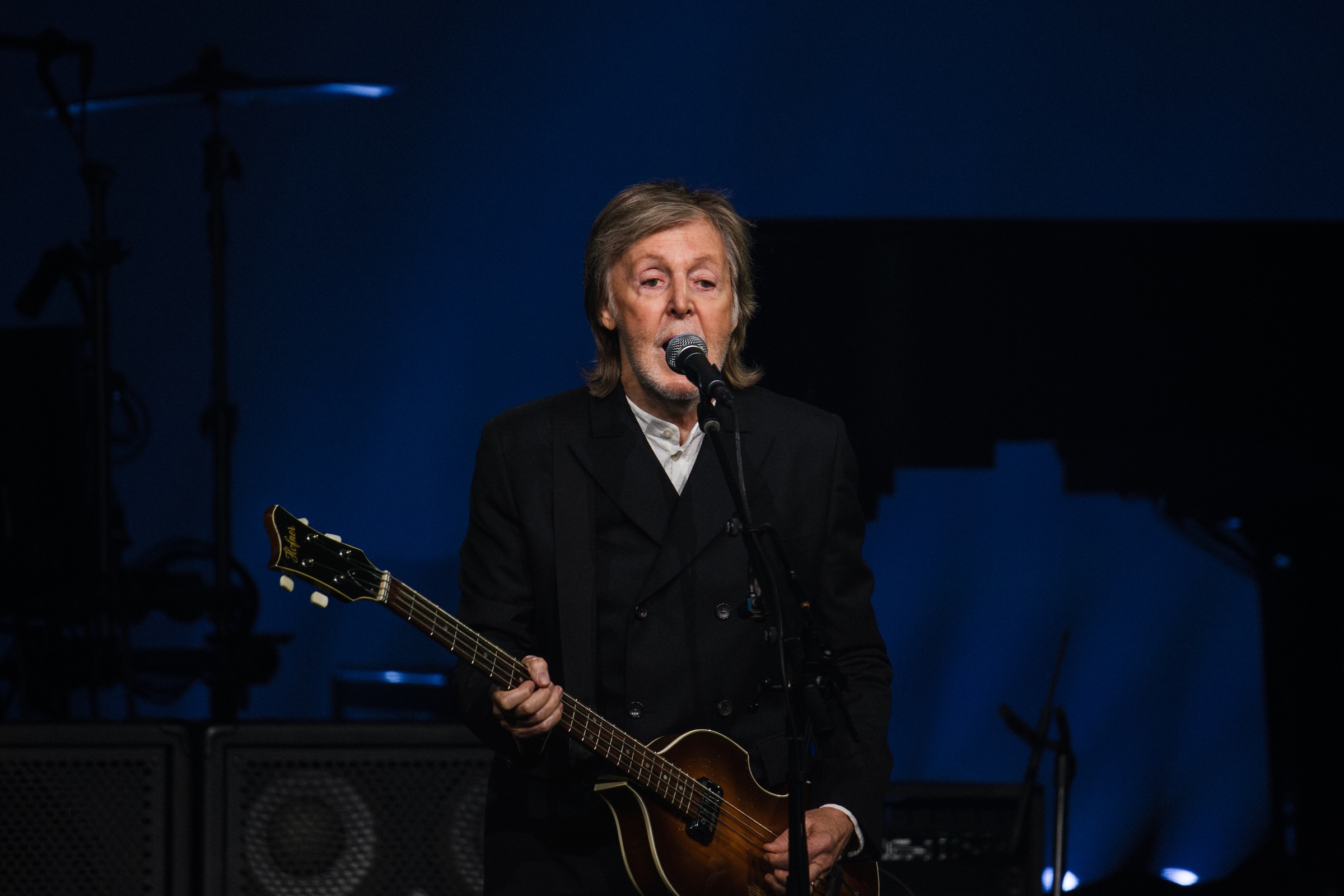
Despite performing thousands of concerts over the last 70 years, with and before The Beatles, Wings, and in his prolific solo career, the legendary Sir Paul McCartney only formally played Nashville for the first time in 2010, at Bridgestone Arena, returning in 2013 to headline nearby Bonnaroo, and playing Bridgestone once more the following year (he came as close as Memphis with The Beatles in 1966, and spent six weeks in the Nashville area recording and exploring with Wings in 1974, though never actually performed in Music City during all of those years). In the more than decade since, it had been unclear when- or even if- the iconic artist might ever return to Nashville, and we’d nearly given up hope when, back in the summer, McCartney revealed not only a new Nashville date, but also his most intimate show in Music City ever, at new 4,500-capacity venue The Pinnacle. Unsurprisingly one of the hottest ticket his current tour, which is mostly taking place in arenas (though a few other special, smaller shows have happened here and there), seeing the 83-year-old McCartney at this stage in his unparalleled career, in a room so intimate, felt like a dream come true, and we were beyond fortunate to have witnessed it in person. Read on for our review from editor Philip Obenschain, with photos from Mary-Beth Blankenship!

A lifelong Beatles fan and McCartney fan, I was pinching myself from the moment I learned about this show until the moment Macca actually set foot on stage- an artist who could fill a football stadium, playing in a room so cozy he could see every single person’s face. The one and only other time I’d seen Sir Paul in person was at his Bonnaroo headliner 12 years ago, which was an epic, sprawling, nostalgic, three-hour set, and still remains one of the greatest performances I’ve witnessed in close to 20 years of attending Bonnaroo. Since then, I’ve been hoping to see him live once more, while his live show is still such a spectacle, and he’s still logging dozens of dates each year, and I could not have asked for a more special, unique concert setting than this one (ok, maybe The Ryman, but I won’t get greedy in my musical daydreaming).
I don’t believe this is the case for all of his shows, but The Pinnacle was a phone-free experience, meaning I had to lock all of my devices into a Yondr pouch on the way in, and experience the rest of the night with no phone and all vibes. As an elder millennial, I’m just old enough to have experienced the smartphone-free concert days for a few years, and I do love the sense of presentness it creates when you remove phones and constant recording from the equation (though I ended up getting a fantastic spot mere feet from the stage, so I’d be lying if I said I didn’t find myself instinctively reaching for my phone a few times to capture some would-be stellar pics). Paul seemed to really enjoy this dynamic as well, remaking a few times throughout the night how we were all having a lovely phone-free experience.

There was a line down the block before the doors had even opened, and after funneling everyone into the venue (Nashville’s newest major show spot, and a really well-designed- if somewhat utilitarian- space, with lots of great sight-lines, and plenty of open spaces and amenities), the room was buzzing with anticipation. Paul was slated to go on at 8, sans opener, but I believe he took the stage closer to 8:30 (no phone, no smartwatch, no sense of time all evening). Scanning the crowd, I noticed that, as expected, it was much older than I typically see at shows, and I’m sure there were more than a few McCartney fans who’d been listening since The Beatles’ 1960s heyday. There were plenty of younger folks as well though; The Beatles are, without a doubt, the most influential band in the history of popular music, and their and McCartney’s reach and legacy most certainly transcends generations (if anything, the age disparity here might have been more economic; this was not an easy ticket to score). There were also lots of VIPs in the house, including Paul’s wife Nancy, his daughter Mary, and even pop star Sabrina Carpenter, who’d headlined Bridgestone Arena the preceding two nights.
When McCartney and his band did finally take the stage, it was to open with Beatles classic “Help!,” a song he only recently began playing live for the first time since the ’60s (a lot of people probably think of The Beatles as a monolithic unit, but the individual Beatles seem to think of it more as a collective, treating individually-penned songs as their own, so when Paul plays Beatles songs, they’re almost always his Beatles songs, and in the case of “Help!,” it was primarily written and sung by John Lennon; so bringing it back for this tour is not only some lovely fan service, but a nice tribute to McCartney’s late bandmate). The room instantly became electric with cheers, singalongs, Beatlemania-esque screaming, all with a collective, palpable understanding that we were in the presence of true greatness. Donning a suit and rocking his signature violin-style bass guitar, the octogenarian McCartney looked as vibrant and energetic as I remembered from 12 years ago, and his stamina would prove impressive as ever throughout the night’s sprawling, more than two-and-half-hour, career-spanning yet.

Pivoting straight from classic Beatles into one of the few songs of the night from his solo (non-Wings) discography, 1980’s new wave-y, dance tune “Coming Up,” from McCartney II, was so much fun to hear live, especially after recently catching a film festival screening of upcoming McCartney doc Man on the Run, which explores his life in the first decade post-Beatles, and essentially ends with the release of II. It also provided a good pulse check for who in the audience was more Beatles fan, and who really knew the whole McCartney oeuvre, as I spotted some of the diehards really loving this tune so early in the night. A giant video screen backed Paul and the band, used intermittently throughout the show to provide visuals, play archival footage, and, in this instance, clips of the vibrant and campy music video for the song, making the whole night feel like a really profound retrospective of an unbelievable, seven-decade-spanning career like no other. Not exactly an eras tour, per se, as such a show would be at least eight hours long, but certainly a celebration of career highs, and some of the most important music ever made in modern history.
McCartney’s long-time backing band- guitarists Rusty Anderson and Brian Ray, keyboard player and multi-instrumentalist Wix Wickens, drummer Abe Laboriel Jr., and late 2010s addition, horn trio Hot City Horns (trumpet player Mike Davis, trombonist Paul Burton, and saxophone and clarinetist Kenji Fenton)- half of whom are American and the rest English, operate like a well-oiled machine, giving proper spotlight to the superstar, while also shining through with the camaraderie and tightness of a true band, and not just a group of hired guns (no surprise there- most of them have been with Paul for decades). As the set moved on to more classic Beatles- “Got to Get You Into My Life” and “Drive My Car”- the band transported through a time machine of tones, channeling that real ’60s psychedelic Beatles feel, and providing tight harmonies and backing vocals, all as the audience echoed back a wall of exuberant singalongs. After Wings’ “Letting Go,” McCartney introduced the next cut as “a new one, you might not know it,” proceeding to play one of only a couple of songs of the whole night that was released in the 21st century, “Come on to Me,” from 2018’s Egypt Station (I was quite surprised not to hear anything from his most recent solo effort, McCartney III, but I’m certainly not complaining that he largely stuck to the classics).

Paul clearly puts a lot of thought into this gigantic sets and their sequence, following the newer tune with one that was sure to pull the crowd right back into nostalgia: Wings’ “Let Me Roll It,” one of several songs from defining classic Band on the Run which would appear throughout the rest of the show. Even 50 years after its release, McCartney still has that powerful vocal growl, that earnest delivery, the ability to channel that propulsive groove. Switching beforehand from bass to guitar (and removing his jacket in the process, revealing its colorful liner and joking it would be the evening’s one and only wardrobe change), Paul added a snippet of Jimi Hendrix’s “Foxy Lady” at the end, and then spoke a little about spending time with Jimi in the ’60s, lamenting his greatness. McCartney devoted a lot of time throughout the night bantering with the crowd, cracking jokes, reading signs, and telling stories; keenly aware of his legacy and the nostalgia and connection to it his fans feel. He seemed to really make a point not only to select a diverse array of some of his most important music to perform, but also to really interact with the crowd, and to honor the past, giving insight into moments in Beatles history, sharing memories of his departed bandmates, and expressing immense gratitude for the shared experience and lasting legacy of these songs.
After a psychedelic romp through Sgt. Pepper’s tune “Getting Better,” Sir Paul took a seat behind his grand piano for the first time of the evening, performing one of the more underrated, later-career Wings songs of the night “Let ‘Em In,” before dedicating the following tune, the other of just two recent solo songs of the night, “My Valentine,” to his wife Nancy, who he announced was in the crowd, in one of the evening’s most tender and personal moments. He’d remain behind the piano for a couple more songs- another Band on the Run classic, the dynamic and groovy “Nineteen Hundred and Eighty Five,” and one of his most iconic post-Beatles songs ever, “Maybe I’m Amazed,” from debut 1970 solo album McCartney. As great of a rocker as he is in the more propulsive, guitar-forward numbers, Paul McCartney really has a special knack for making ballads soar more than most any other artist alive, and behind the piano, playing such epic, sweeping, and heartfelt songs, he becomes transportive, landing with such a deep emotional weight and profundity. Seeing visuals of Paul on the screen from his life back then only added to the power of songs like this, and to the celebratory nature of this entire performance.

Back on acoustic guitar, McCartney played one more from Help!, “I’ve Just Seen a Face” (the set would feature songs from every Beatles record from 1965-1970, save for Yellow Submarine), before taking a moment to banter and read some signs in the crowd, while his band gathered around him in a semi-circle, Wickens on accordion and Laboriel Jr. on an upright drum kit, as Paul spoke about his days even before The Beatles, proceeding to play something I never thought I’d ever see live- a song by The Quarrymen, his teen band with Lennon and Harrison from the ’50s. Talk about a serious nostalgia trip! He then played the night’s one and only early period Beatles song- a fitting transition from The Quarrymen- breakout single “Love Me Do” from debut album Please Please Me, which, though also quite antiquated by later-period Beatles standards, really helped this set feel like a complete retrospective of a living legend. Next, and for the first time this tour, McCartney played blissful solo tune “Every Night,” from McCartney. Then, for the final song of this more stripped-down stretch, the band exited the stage, leaving Paul alone with his acoustic guitar to play one of the most lovely and iconic Beatles ballads ever written, “Blackbird,” alone, earnestly, and profoundly, met with lovely singalongs from the crowd.
A psychedelic-colored upright piano was brought out next, and McCartney performed one of the more surprising songs of the evening: “new” Beatles tune “Now and Then” (if you’re unfamiliar with the lore, it’s basically a John Lennon demo from the 1970s, which was worked on with two other “new” Beatles songs after his passing, which were ultimately released in the ’90s, but shelved until it could be finished with machine learning a couple years ago, finished by McCartney and Ringo Starr, with tracks from George Harrison from before his 2001 passing- basically, a sort of Beatles song that was never quite meant to be one). With its music video behind him, which superimposes McCartney and Starr into archival footage with Lennon and Harrison, it served as the night’s second pointed tribute to Lennon, made more powerful when Paul starred silently at the footage of his old friend singing. He’d remain at the piano for another Beatles number, “Lady Madonna,” before once again returning to the violin bass for start of the show’s stacked final stretch.

Kicking it up a notch and momentarily bringing us back to Wings, anthemic Band on the Run single “Jet” really soared, punctuated with gang vocals from the backing band and punchy horns from the fantastic brass and woodwind trio. Paying yet another tribute to the two departed Beatles (I figured he’d do something like this, but it was really touching how much their presence was felt throughout the evening), Paul next played John-led Sgt. Pepper’s song “Being for the Benefit of Mr. Kite!,” before switching to a ukulele, explaining that it was a gift from George Harrison, and speaking about some fond memories of his late bandmate, before paying tribute to him with a cover of “Something.” Back on bass, he called on audience participation for “Ob-La-Di, Ob-La-Da,” as his band danced whimsically, leading into the final stretch of the main set, packed with some of McCartney’s most iconic songs of all.
Most of the night’s Wings songs were from the group’s most famous album, Band on the Run, so, of course, that classic LP’s title track “Band on the Run” was performed as well, really exemplifying that period of the 1970s were McCartney rediscovered his artistry once more, and entered a really fruitful and career-defining subsequent decade. As the screen flipped to footage from Peter Jackson’s fascinating, intimate recent The Beatles: Get Back doc though, we moved back in time once more, to Let It Be’s “Get Back,” met with deafening cheers and a renewed wave of singalongs. Taking a seat back behind the grand piano and sticking with Let It Be, McCartney moved on next to the classic album’s title track, which, at risk of sounding like a broken record, is one of the most iconic songs ever written (you could pretty much say the same about the next few as well). For the very last non-Beatles tune of the evening, Wings’ most recognizable song of all followed- James Bond theme “Live and Let Die,” which, though not quite as epic a rendition as the full pyrotechnic spectacle I witnessed at Bonnaroo years ago (I think his bigger shows still use pyro here, but it’s not safe for venues this small), still absolutely rocked, and transitioned perfectly into set-closer ballad, “Hey Jude,” which he returned to the upright piano up front for.
What can I say about “Hey Jude” that hasn’t been said more adeptly by critics and fans over the last 60 years? There’s a reason it’s one of The Beatles’ most recognizable songs, one of McCartney’s signature hits, and why he closes his show with it; it’s a perfect ballad, a perfect song to sing along to, and it feels just as fresh and inspired today as in 1968. Belting it out behind the piano, more than two hours in, Paul was magnetic, and had the show truly ended there, it would’ve still been a perfect one. But, of course, even after the thank yous and bows and ear-splitting applause, there a generous, all-Beatles encore still to come.

Just minutes later, McCartney and his band reemerged, waving four giant flags- the U.S., the UK, Tennessee, and Pride- before grabbing their instruments again (Paul back on guitar) for one more Let It Be tune, “I’ve Got a Feeling” (featuring one final archival clip of Lennon singing his parts on the screen behind). “Sgt. Pepper’s Lonely Hearts Club Band (Reprise)” was next, McCartney back on bass, which is fitting for an encore, though I would’ve loved a rendition of the main track of the same name. But I didn’t have time to dwell as Paul launched right into “Helter Skelter” right after- for my money, one of the most interesting and ahead-of-its-time Beatles songs ever, and one that absolutely rips live, especially when you remember that’s a man in his 80s completely rocking what is effectively a proto-metal song. The last half of the six-song encore all came from Abbey Road, which tied with Band on the Run for the album that lent the most songs to the set; the last three songs, played in sequence, with McCartney back behind the piano, which flowed just as powerfully and fittingly-conclusive live as on that legendary LP. From the dreamy and brief “Golden Slumbers” into singalong-primed “Carry That Weight” and, finally, and aptly, more propulsive ending song “The End,” the final stretch felt like a perfect punctuation to the sprawling performance, with Paul grabbing a guitar one last time in the middle of the final tune to bring it all home, closing out the show with the lyrics “And in the end / The love you take / Is equal to the love you make” – the very last line from the very last Beatles album ever recorded (Let It Be was released last, but Abbey Road was record last), serving both as a fitting closing statement for the greatest band in pop history, and as perfect concert closer this evening for McCartney himself.
Words can’t describe how important Paul McCartney is to music and culture at large- though I’ve done by best here to try, at least through the lens of this singular experience. A Beatle, a Knight, a musical trailblazer, and still, many decades later, one of the most singularly powerful and profound performers on the planet (even if he seems genuinely humble about all of it), to see this living legend at all, much less in a rare, small performance context, is such a gift, and such a beautiful experience, and one that I’ll cherish for the rest of my life. I’m not sure when he’ll make his way back to Nashville, but if you couldn’t get in to this show, I encourage you seek out Sir Paul live anywhere, anytime, at least once in your life.
_
All photos by Mary-Beth Blankenship


All photos by Mary-Beth Blankenship
_
Setlist:
Help!
Coming Up
Got to Get You Into My Life
Drive My Car
Letting Go
Come On to Me
Let Me Roll It
Getting Better
Let ‘Em In
My Valentine
Nineteen Hundred and Eighty-Five
Maybe I’m Amazed
I’ve Just Seen a Face
In Spite of All the Danger
Love Me Do
Every Night
Blackbird
Now and Then
Lady Madonna
Jet
Being for the Benefit of Mr. Kite!
Something
Ob-La-Di, Ob-La-Da
Band on the Run
Get Back
Let It Be
Live and Let Die
Hey Jude
I’ve Got a Feeling
Sgt. Pepper’s Lonely Hearts Club Band (Reprise)
Helter Skelter
Golden Slumbers
Carry That Weight
The End