
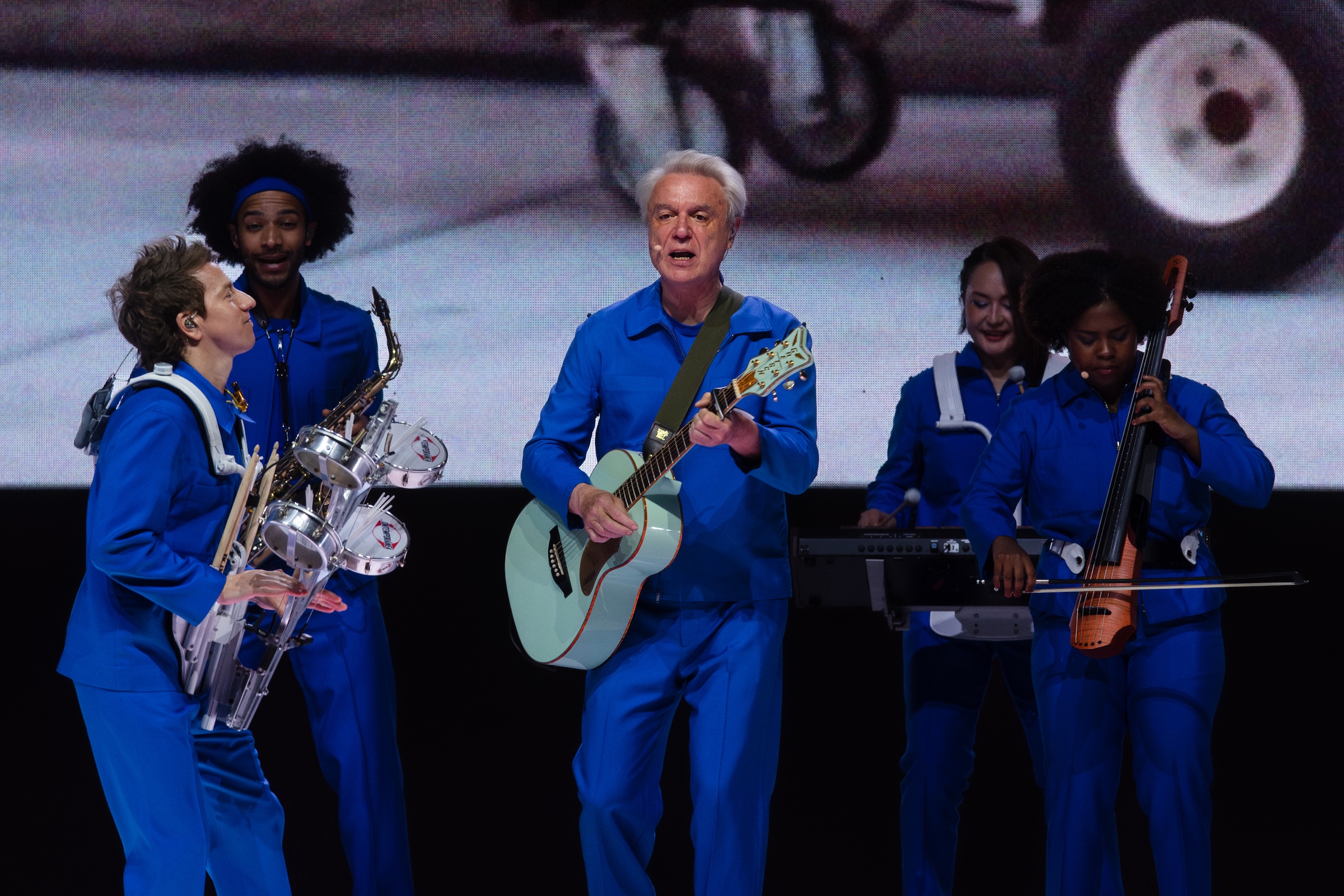
David Byrne
Ascend Amphitheater; Nashville, TN
May 9, 2026
Review by Philip Obenschain. Photos by Mary-Beth Blankenship.
As I learned when I was fortunate enough to witness his incredible American Utopia Tour eight years ago at The Ryman (or, really, the first time I saw his former band Talking Heads’ legendary concert film Stop Making Sense), there is no one else in the world who puts on a performance quite like David Byrne. One of the most beautiful, immersive, original, and imaginative concerts I’ve ever witnessed, American Utopia ultimately wound up doing two runs on Broadway- the perfect place for a concert so theatrical and thoughtful- and was filmed by Spike Lee for an HBO concert film and documentary. Though only the latest creative endeavour in a rich, multifaceted career that extends back to the early ’70s, had that record and lauded performance cycle been Byrne’s late-career crowning achievement, it would’ve been a hell of a high note to retire on. But the now 73-year-old quintessential New Yorker is as vibrant, creatively invigorated, and as sociopolitically mindful as ever, connecting with a new generation of artists in really meaningful and surprising ways (like performing with and covering both Paramore/Hayley Williams and Olivia Rodrigo), and continuing to make some of the best art of his career, across a variety of mediums, especially last year’s fantastic American Utopia followup Who Is the Sky?, recorded with New York’s Ghost Train Orchestra (and produced by Kid Harpoon).
I truly could not conceive of any live show topping the mesmerizing experience that was American Utopia, but when I heard that David was set to return to Music City for the first time in eight years- his largest headliner yet at Ascend Amphitheater, after many stops at The Ryman since the turn of the century (and, before that, shows in the late ’70s and early ’80s at Exit/In, Vanderbilt, and Municipal Auditorium with Talking Heads)- I was beyond elated to see what his latest live show would entail. Keep reading for my full review, but in short: the Who Is the Sky? Tour is everything American Utopia was and more, and is, without a doubt, the most essential concert of the year, from one of the greatest performers to ever exist.

May in Nashville can be iffy for outdoor concerts (which is probably why Ascend’s schedule is looking pretty light in the coming weeks), between tornado season, spring storms, and occasional heat waves, but Mother Nature must be a David Byrne fan, because it was absolutely perfect out as I arrived to the amphitheater. I noted that the crowd was quite diverse, and I spotted several familiar faces from the local music scene- a testament to Byrne and the Talking Heads’ enduring influence on younger artists and pop culture- but, on the whole, it was a bit of an older crowd on average (I wondered who around me might’ve caught those Talking Heads shows here decades ago). This tour has been going on since last year, but I’d largely managed to stay unspoiled from seeing clips of what exactly it would look like, leaving me to gawk at the massive (and I mean MASSIVE) wraparound video screens, situated as panels all behind the stage (and, as I would soon notice, along the floor as well). As expected, I saw no instruments on stage, meaning Byrne and co. would again be performing in a mobile configuration, with each and every instrument (including percussion) strapped to or carried by his backing band (who are so much more than a band- they’re essentially part of a performing arts troupe).
There was no opener at all, but the show began half an hour after its posted time to give everyone a chance to arrive, with a pre-recorded announcement from Byrne signaling they would soon take the stage, and jokingly confirming that “the venue permitting dancing, but not to dance in the aisle, as it would be an unfair advantage in case of a fire.” A few minutes later, the legendary artist, donning a monochromatic blue outfit (which his troupe would all match) and headset mic, took the stage with an abbreviated version of his band- just strings and keyboard- for a stripped-down version of Talking Heads’ “Heaven” to begin the show. I was immediately transfixed by the scale and dimension of the screens, which opened with David and the band appearing to be on the moon (with the ground itself lighting up to match), an illuminated Earth behind them. Where American Utopia trended more tactile and minimalist, set in a grey, angular, cube-like stage made up of shimmering curtains of aluminum chains, with Byrne and the band adding to the desaturation by donning grey suits, Who Is The Sky? was high-tech, colorful, and vibrant; half sequel, half aesthetic evolution. Every second of the show, every image, every movement, even down to the thoughtfully sequenced setlist, clearly involved so much planning, so much design, and so much elaborate orchestration, and the result was nothing short of revolutionary.
For the first solo song of the night- fittingly, Who Is the Sky?‘s lead single “Everybody Laughs”- the band expanded to its full configuration, with the additional instrumentalists and backing singers appearing from within the panels of the stage, and joining Byrne in choreographed movement, as videos of New York lit up behind them. If Talking Heads’ legendary Stop Making Sense show conjured the feeling of a play- act breaks, costume changes, theatricality, and props- what Byrne is doing now almost feels more like a ballet, with so much of its artistry conveyed through movement (and, sure, a bit of the feeling of a marching band and a visual art installation wrapped in there too). The setlist was almost exactly half Talking Heads, half Byrne solo, and was designed not only to flow well sonically, but also seemed very thematically deliberate. Later period Talking Heads tune “And She Was” (famously, the band had stopped touring before their mid and late ’80s output, so the only way these some of these songs ever made it to a live show is through Byrne) was backed by aerial shots of nature and neighborhoods), flowing into Byrne & Brian Eno’s dance-primed “Strange Overtones,” where the visuals transformed to a rooftop amidst the New York skyline. Throwing it back next with classic Talking Heads song “House in Motion,” and moving to images of the New York streets, the performers really showcased how much the lighting and mood of the visuals could morph to suit the song, suddenly conjuring the feel of a glowing, retro New York club scene at the start of the ’80s.

One of Byrne’s quirkier recent songs- non-album single “T-Shirt”- also made for one of the night’s most Instagrammable backdrops, as the stage filled with would-be t-shirt slogans- some funny, some cheesy and deliberately cliché, some seemingly tailered to Nashville, some politically poignant, like a prominent “Make America Gay Again.” I noticed that while he did address the audience in between songs, interjecting with stories, quips, jokes, praise for his band, pleas for love and kindness, and expressing gratitude towards the audience, Byrne left a lot of the sharpest socio-political commentary to the visuals, letting the profundity of his art and of this show ring the loudest. Another of those later Talking Heads songs, “(Nothing but) Flowers,” sounded great and really served to cover the breadth of that band’s output (comparatively, there weren’t many old songs from Byrne’s solo discography), but it was subsequent tune “This Must Be the Place (Naive Melody)” that really lit up the audience more than anything else that point, as foggy, wooded backdrops perfectly matched the breezy, emotional delivery of the classic hit. Before the show, I found myself double-checking that local rocker Hayley Williams was, in fact, still on tour, since she’s a huge fan and prior collaborator of Byrne’s, and almost certainly would’ve joined him on stage for “What Is the Reason for It?” (even in her absence, the thumping, mariachi-conjuring song still sounded great).
Before a really hit-filled, Talking Heads-leaning final stretch, the latter middle of the show featured a section of mostly solo songs, including a couple of deeper cuts (this is where I admit that as much as I love Byrne and the Talking Heads, his pre-2010s output is something I didn’t really dig into until much later). “Like Humans Do,” from 2001’s Look into the Eyeball, featured one of the evening’s most memorable visual pairings, with David and the band all donning different animal heads on the screen behind them, while dancing in sync as their normal selves below (at first I thought this was some kind of AR, mapping those heads onto them in real time, but after noticing some minor discrepencies in their movement, and also how tacticle the masks looked, I concluded it must’ve been pre-taped). “When We Are Singing” continued the visual surreality- seemingly the aesthetic theme for this block- with zoomed-in visuals of the troupe’s mouths, and the set’s oldest solo song, “Independence Day,” from 1989’s Rei Momo, saw them once again transported to space, as the names of the band floated in the sky and followed them around the stage. The solo stretch was briefly interrupted by another welcome Talking Heads track, “Slippery People,” with fast-moving waters filling the screen in conjunction with the groovy, dance-primed classic (as David had hoped for in his pre-show announcement, a ton of the crowd- especially the older fans around me- danced all throughout the show).

After what would be the show’s final two tunes from Who Is the Sky?, “I Met the Buddha at a Downtown Party” (which he introduced with a humorous history lesson about The Buddha, and which featured some of the most visually striking dance choreography of the entire evening) and “My Apartment Is My Friend” (where the stage suddenly transformed into a mesmerizing visual recreation of Byrne’s real-life New York apartment- one of the coolest projections of the night- which he spoke about candidly, having spent time there alone and isolated during Covid), it was time for another run of Talking Heads classics. For vibey Fear of Music track “Air,” the screens transported the group to- you guessed- the air, as the choreo became light and flowy. One of the biggest Talking Heads hits missing from the American Utopia set (and apparently, a song Byrne hadn’t been performing live for nearly 20 years), “Psycho Killer” saw the backdrop largely dim, illuminating the band with a glowing light from below, and was delivered with such freneticism and passion that you could really feel that transcendant, trailblazing new wave and art punk spirit that propelled Talking Heads onto the scene almost 50 years ago (unsurprisngly, myself and everyone around me lost our damn minds at this song). The end of the show approached as things cranked up (and the staged bathed the blue-clad performers in even more blue) with one more propulsive Fear of Music cut, “Life During Wartime,” projecting even more timely and powerful images like protests and clashes with ICE. And, to end the main set, the blue became orange as the shimmering intro of “Once in a Lifetime” began, with Byrne’s delivery landing so urgently and confidently, that it almost had the intonation of a rallying cry from a podium. Perhaps the most iconic song from a band with no shortage of iconic songs, hearing the enduring classic live absolutely never gets old, especially in this special, unorthodox performance style, and it’s really quite stunning how incredible and vibrant David still sounds after all these years.
There was, of course, an encore, which David introduced by speaking about the feeling of the world first opening up again post-pandemic, and attributing the special arrangement of “Everybody’s Coming to My House” to Harlem’s Abyssinian Baptist Church Choir (the only track from American Utopia), giving the song a more stripped-down and social and vocally rich new life, as the band and vocalists gathered around a hanging lightbulb. Though lovely, soulful surprise transitioned straight into the very last song of the night: “Burning Down the House” (giving all of the Talking Heads diehards one last opportunity to absolutely lose it), which saw the full troupe get one more time to shine, ultimately ending up stretched across the stage in a line as their names rolled on the screen like movie credits (honestly, more tours with large ensembles should try this). It was a perfect end to a perfect show; one that felt so much smarter, so much deeper, and so much more creative than 99% of tours today. An artist and an intellectual and a multidisciplinary creative, who has never stopped pushing boundaries and evolving his craft and staying relevant and dialed in with cultural change, there has never been another musician quite like David Byrne, and there has certainly never been another performer inventive enough to do so many of the things he has across six impressive decades of touring. This was a beautiful and rich and soul-affirming experience, and one I hope will inspire even more artists to be as creatively uninhibited as possible. David Byrne, the icon you are.
_


All photos by Mary-Beth Blankenship
_
Setlist:
Heaven *
Everybody Laughs
And She Was *
Strange Overtones ^
Houses in Motion *
T Shirt
(Nothing but) Flowers *
This Must Be the Place (Naive Melody) *
What Is the Reason for It?
Like Humans Do
When We Are Singing
Independence Day
Slippery People *
I Met the Buddha at a Downtown Party
My Apartment Is My Friend
Air *
Psycho Killer *
Life During Wartime *
Once in a Lifetime *
Everybody’s Coming to My House
Burning Down the House *
* Talking Heads song
^ Brian Eno & David Byrne song